
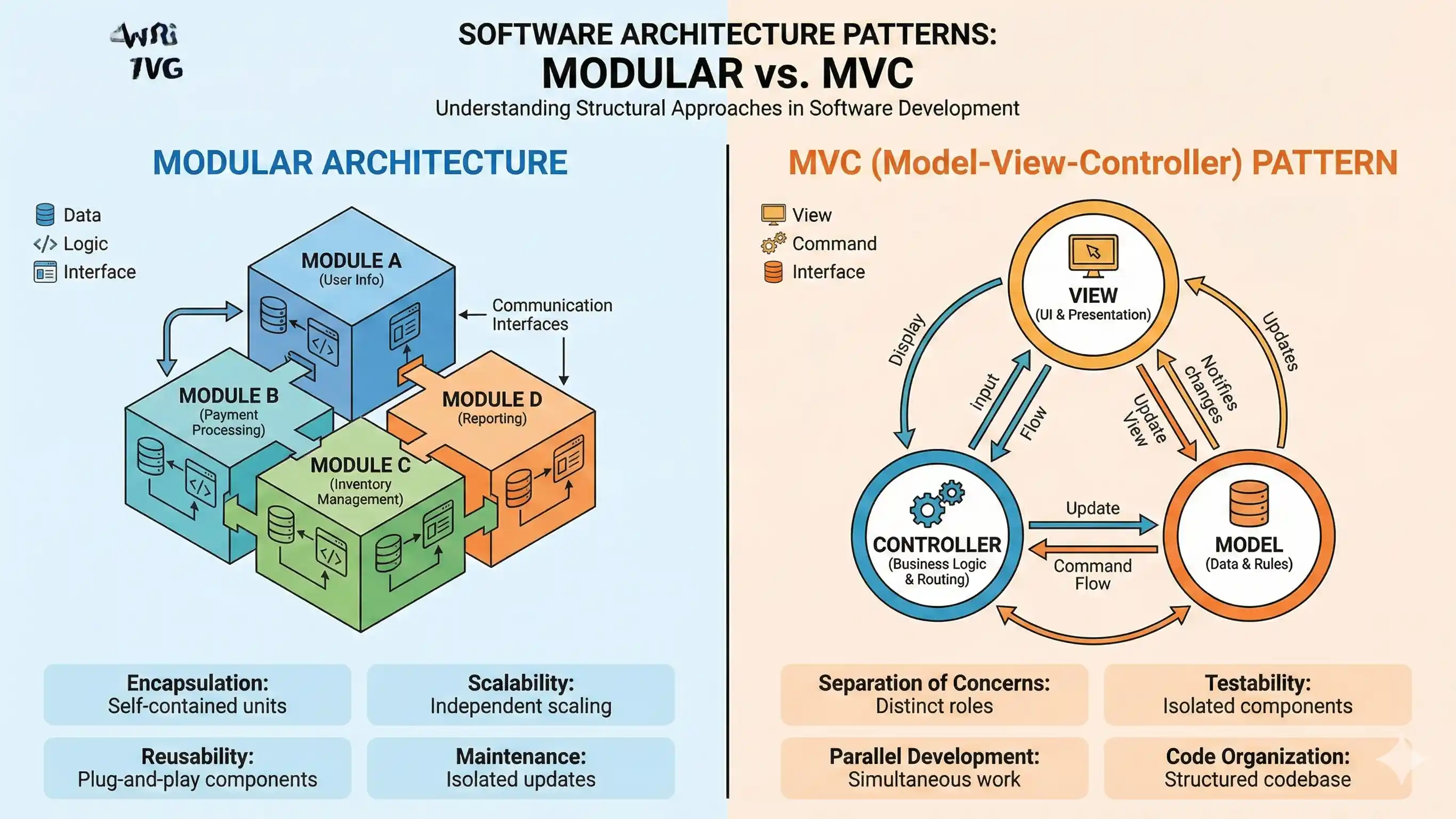
Modular vs MVC Pattern: Which Architecture Should You Choose?
Have you ever opened a massive codebase and found yourself expanding a controllers folder containing 50 completely unrelated files? And then, to fix a simple bug, you had to jump over to a models folder, and then track down the corresponding logic in routes?
If that sounds like a headache you've dealt with, you’ve officially hit the limits of traditional MVC.

Choosing how to structure your backend application is one of the most critical decisions you make early on. Today, I want to break down the classic MVC (Model-View-Controller) pattern versus the modern Modular (Feature-based) architecture, skip the academic definitions, and share some real-world thoughts on when to use each.
The Classic: MVC (Model-View-Controller)
MVC is the architectural pattern that most developers encounter first. Frameworks like Express, Ruby on Rails, and raw PHP made it incredibly famous.
The philosophy behind MVC is simple: Group code by its technical role.
Here is what a typical MVC file structure looks like:
src/
├── controllers/
│   ├── auth.controller.ts
│   ├── product.controller.ts
│   └── user.controller.ts
├── models/
│   ├── product.model.ts
│   └── user.model.ts
├── routes/
│   ├── auth.routes.ts
│   ├── product.routes.ts
│   └── user.routes.ts
└── views/ (or templates)
The Best Parts of MVC
- Lightning Fast to Start: When you have a small project, knowing exactly where to put a database schema (in
models/) or an API endpoint (incontrollers/) means you don't have to overthink. - Universal Language: Almost every backend developer on the planet understands MVC. If you bring a new hire onto an MVC project, they instantly know where to look.
The Problem with MVC
MVC breaks down as your application scales.
Let's say you decide to remove a "Reviews" feature from your app. In MVC, you have to delete reviews.controller.ts, track down reviews.model.ts, find the routes scattered in the routes directory, and hunt down any views. Your feature is fragmented across the entire codebase.
The Modern Approach: Modular Pattern
The Modular pattern (often referred to as Feature-driven, or Domain-Driven architecture) flips MVC completely on its head.
Instead of grouping code by its technical role, you group code by its business feature. Everything related to a given domain lives in one specific folder.
Here’s what that looks like:
src/
├── modules/
│   ├── auth/
│   │   ├── auth.controller.ts
│   │   ├── auth.routes.ts
│   │   └── auth.service.ts
│   ├── products/
│   │   ├── product.controller.ts
│   │   ├── product.model.ts
│   │   └── product.routes.ts
│   └── users/
│       ├── user.controller.ts
│       ├── user.model.ts
│       └── user.routes.ts
Why I Default to Modular
I'll be honest: once I switched to building modular applications in Node.js, I never went back. Here is why:
- Context is King: When I am working on the
usersfeature, I only have to open theusersfolder. The routes, the database model, the business logic—it's all localized. The cognitive load goes way down. - Dead Simple to Delete or Extract: Remember that "Reviews" feature we wanted to delete? In a modular architecture, you just delete the
modules/reviewsfolder. Done. If your application grows so massive that "Reviews" needs to become its own microservice, extracting a single folder is vastly easier than untangling MVC spaghetti. - Fewer Merge Conflicts: In team settings, Alice can build the
Billingmodule while Bob works onProducts. Since they aren't both editing the same massive genericroutes.tsfile, your git history stays completely clean.
The Downside to Modular
It really can feel like overkill for tiny apps. If your app only handles users and a few static pages, creating deeply nested feature folders is just going to slow you down.
The Showdown: Which should you choose?
We all love a definitive answer, so here is my personal cheat sheet:
- Choose MVC if: You are building a quick prototype, a hackathon project, or a rapid MVP that won't evolve into a massive enterprise app. It's fast, predictable, and straightforward.
- Choose Modular if: You are building a production-grade API, working with a team, or suspect your codebase will grow beyond 10-15 different entities. It will literally save your sanity six months down the line.
Wrapping Up
There is no "wrong" choice here—architecture is always about tradeoffs. However, as backend development matures (especially in TypeScript ecosystems where frameworks like NestJS force modularity by default), the industry is heavily shifting toward the modular pattern for maintainability.
Try refactoring one of your older side projects into a modular architecture. You might just find it's the exact organizational paradigm you've been waiting for!